
Smart Roofing
Smart Roofing
Choosing the right roofing tile for a low-slope roof is crucial for its durability, watertightness, and aesthetics. Keep in mind that not all tiles are designed for this type of structure, so it's very important to understand all the available options, their advantages, and technical specifications.
From Tile World, we offer you this short practical guide to help you select the best tile according to the roofing time, climate and installation requirements.
Technical requirements for low-slope roofs
Before choosing a ceramic tile, it is essential that you know the technical requirements that low-slope roofs must meet to ensure good performance and avoid leaks.
Minimum recommended slope according to regulations and tile type
The Technical Building Code (CTE) establishes minimum slopes depending on the type of tile and the installation system. For example, flat tiles require at least a 30% slope, while curved or mixed tiles can be installed with slopes as low as 25% (if laid with mortar).
Risks associated with insufficient slopes: seepage and water accumulation
An insufficient slope increases the risk of leaks and water accumulation on the roof . These situations often lead to dampness, dripping, and other structural damage. An improper slope prevents rainwater from draining properly, causing it to stagnate and reducing the lifespan of the materials.
Adaptation of the cover design to ensure watertightness
To adapt the roof design, choosing the right tiles is essential. In addition, the slope must be optimized within permitted limits, and complementary systems (waterproof membranes) should be applied. A well-planned design prevents leaks and moisture problems.
Characteristics that a tile for low slopes should have
Roofing tiles for low slopes must meet a series of specific characteristics to offer good performance against water, wind or humidity.
Geometry, fit and water drainage capacity
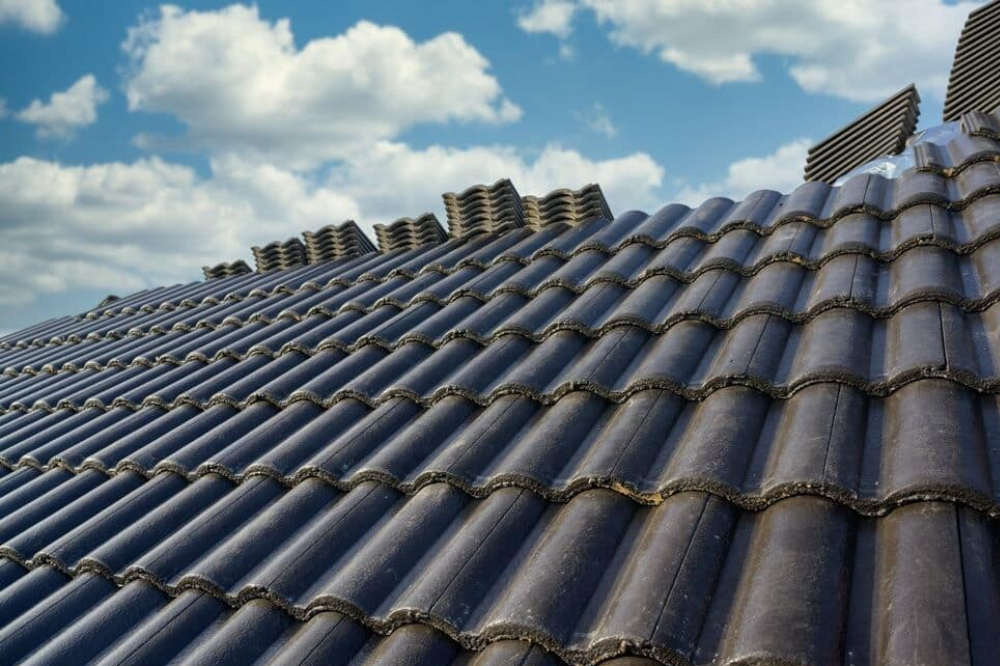
Ceramic roof tiles must have a geometry that allows for a perfect fit between the pieces. Furthermore, it is very important that they have wide and deep channels to improve water drainage. Only in this way can you enjoy more effective and durable coverage against heavy or prolonged rainfall.
Importance of overlap and correct alignment in installation
Proper installation prevents leaks, ensures continuous water flow, and improves wind resistance. Conversely, poor installation will compromise watertightness and shorten the roof's lifespan.
Behavior in the face of wind and heavy rain
Ceramic roof tiles on a low slope must be securely fastened with watertight joints and a design that allows for drainage. This prevents them from being lifted by strong gusts of wind and minimizes the risk of leaks during rain.
Technical solution with Tile World® on low-slope roofs
The Tile World is designed to guarantee maximum watertightness and durability in low-slope roofs.
How does the system allow for safe installation below the traditional minimum slope?
Thanks to its innovative design, the Tile World allows for safe installation even on slopes below the traditional minimum. It achieves this by combining precisely fitting tiles with a waterproof membrane and specific components that reinforce watertightness. This system delivers excellent hydraulic and structural performance in all types of weather conditions.
Key elements of the Tile World® that prevent leaks
The tile world incorporates key elements such as perfectly fitting tiles, a high-strength waterproof membrane, and a ventilation system that prevents moisture buildup. These components work together to provide maximum watertightness, even on low-slope roofs exposed to heavy rainfall.
Real-world cases and tests that support its performance on complex roofs
The performance of Tile World on low-slope roofs has been validated by tests conducted by the Eduardo Torroja Institute of Construction Sciences (IETcc) . These tests included water tightness tests under wind conditions.
Furthermore, the system has the Technical Suitability Document Plus (DIT Plus) number 622p/22, which certifies its compliance with the Technical Building Code (CTE) in Spain.